Asch (1951) Line Study
AO1
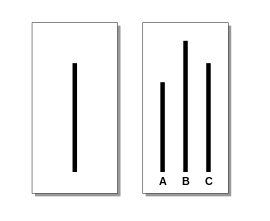
Procedure-
5-7 participants in a group, each participant given a standard line, and three comparison lines (see above). Participants then had to say aloud which line they thought matched the standard line.
Each group had one true participant with the rest of the group being confederates (actors), that were told to give the wrong answer in 12 out of 18 trials.
Results-
The true participants conformed on 32% of the critical trials, where confederates gave the wrong answer. 75% of the sample conformed at least once.
AO3 Evaluation-
+Gives support to normative influence as participants said they agreed with the majority, even though they knew deep down they were wrong
-Lacks ecological validity, judging lengths of lines is not reflective of daily life, or conforming in real life settings
-Gender bias, the study is androcentric and focuses on males only and ignored females, meaning the study can only be applied to the male population
-Deception, the study suffers issues of ethics due to participants being deceived to the real aims of the study, resulting in them not giving informed consent and risking embarrassment for wrong answers
Factors affecting conformity
Between 1952-1956 Asch manipulated the procedure (IV) to investigate which situational factors influenced levels of conformity (DV)
- Group size
-group sizes were altered to see the effects it had on group conformity. The bigger the majority, the higher level of conformity, until a certain point.
The presence of:
-1 confederate gave 3%
-2 confederate gave 13%
-3 or more gave 32%
-4+ confederates conformity did not increase as much
because of this, groups of 3 to 4 is seen as the optimal group size for conformity.
STUDY LINK
BROWN and BYRNE (1997), suggest that people may suspect cohesion behaviour between other participants if they rise over a number of 4
HOGG and VAUGHAN (1995), the most robust findings show that conformity reaches its full extent with a 3-5 person majority, additional members have little affects on conformity
- Group unanimity
-a person is more likely to conform when all members of the group are in agreement and give the same answer. When one person in the group gave a different answer from the others, and the group answer was not unanimous, conformity levels fell.
STUDY LINK
ASCH (1951), found the presence of just one confederate that goes against the majority choice can reduce conformity as much as 80%.
- Difficulty of task
-when the comparison lines were made similar in length it was harder to judge the correct answer and conformity levels increased. When we are uncertain on something, we look to others for confirmation (informational influence). The more difficult, the higher the levels of conformity.
- Answer in private
-when participants answered in private conformity levels decreased. This is due to the lack of group pressure, meaning normative influences are not as powerful, due to having no fear of group rejection.
 Social Sciences PGCE Austin Foster